
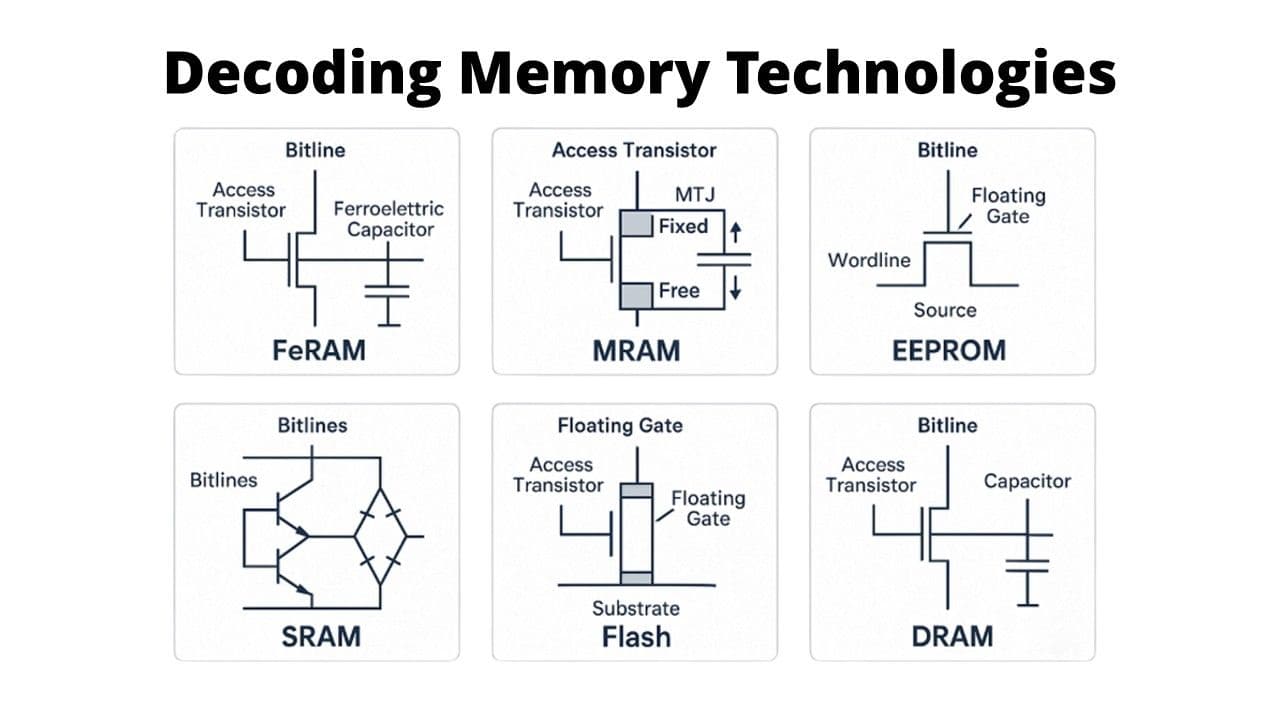
For engineers, the challenge isn’t just understanding how each memory works, it’s understanding why one technology makes sense over another.
This article breaks down the most relevant memory technologies on the market today and highlights their real-world strengths, weaknesses, and typical use cases.
Every design involves trade-offs between:
Understanding these trade-offs is key to making the right decision early in the design phase.
Before diving into individual technologies, it helps to start with one key distinction:
This single factor often defines whether a memory is used for:
Each memory type embodies a distinct set of architectural principles, material compositions, and manufacturing complexities that directly influence its suitability for applications across various industries, such as IoT, automotive, medical, industrial automation, data centers, and edge-AI systems.
In order to be able to select the best memory technology, or the best mix of memory technologies, let’s start with an overview of the most common memory technologies that are used today and how they have evolved.
Takeaway: If speed is critical and cost is secondary, SRAM is your go-to but you won’t use it for large storage.
Takeaway: DRAM dominates wherever large amounts of fast-access memory are required—but power consumption and volatility must be managed.
Takeaway: Flash is unbeatable for cost-effective storage—but not for frequent rewriting.
Takeaway: Still widely used where small amounts of reliable data storage are needed—especially in industrial systems.
Takeaway: If your system writes data frequently and power is limited, FeRAM is a strong candidate.
Takeaway: MRAM is one of the most promising “universal memory” options but cost still limits widespread adoption.
Takeaway: ReRAM could play a major role in future architectures—but it’s still evolving.
Takeaway: PCM aims to close the gap between DRAM and Flash, a space that is becoming increasingly important.
| Application Area | Best Fit Memory Type(s) | Charecteristics |
|
Wearables | FeRAM, MRAM, NOR Flash | Low power, non-volatility, high endurance for extended battery life. |
|
IoT Devices | FeRAM, MRAM, ReRAM | Frequent writes, non-volatility, low power for remote nodes. |
|
Medical Devices | FeRAM, MRAM | Ultra-low power, radiation tolerance, high endurance. |
|
Edge-AI Inference | MRAM, ReRAM, PCM | Non-volatility, fast access, endurance for real-time processing. |
|
Robotics (Industrial) | MRAM, SRAM, DRAM | Speed, endurance, and robustness in control loops. |
|
Data Loggers (Harsh) | MRAM, FeRAM | Radiation-hard, high-endurance memory for continuous data capture. |
|
Energy Harvesting | FeRAM, MRAM | Low standby power, quick wake-up cycles in energy-constrained systems. |
|
Elevator Controls | EEPROM, MRAM, FeRAM | Proven non-volatility, cost efficiency, endurance for industrial use. |
|
Credit Cards/Banking | FeRAM, EEPROM, NOR Flash | Secure storage, non-volatility, moderate endurance for transactions. |
|
AI Training (Datacenters) | DRAM, HBM, PCM | High bandwidth, scalability for massive AI workloads. |
|
Video Rendering Buffers | DRAM, SRAM | High-speed, high-capacity memory for real-time rendering. |
|
Autonomous Vehicles | MRAM, DRAM, PCM | Non-volatility, radiation resistance, bandwidth in safety-critical systems. |
What does this mean for applications? Here’s an overview of what memory is suited for what application and why.
Here is the key insight every engineer should internalize:
|
If you need… |
You typically choose… |
But you sacrifice… |
| Ultra speed | SRAM | Cost & density |
| High capacity | DRAM / NAND | Power or speed |
| Low cost storage | NAND Flash | Endurance |
| High endurance | FeRAM / MRAM | Density & cost |
| Non-volatility + speed | MRAM / PCM | Price |
Answering these questions will guide you to the right memory choice much faster than comparing datasheets.
As electronics become more complex, especially in IoT, edge AI, and industrial systems, memory is no longer just a component. It is a design decision that affects the entire system lifecycle.
When integrating multiple memory types within complex architectures, the guidance of specialists becomes not only valuable but indispensable.
At MEMPHIS Electronic, we navigate trade-offs every day. Because the best designs are not built around “the most advanced memory,” but around the most appropriate one.