

By Nick Florous, Ph.D., Global Director of Product Marketing, MEMPHIS Electronic in collaboration with the Technical Product Marketing Division of Ramxeed
Counterfeit components and consumables erode revenue, jeopardize safety, and degrade user experience across office automation, healthcare, industrial, and consumer markets. Traditional digital authentication via challenge–response with stored keys is increasingly susceptible to key leakage and cloning. We outline a FeRAM-based, encryption-less authentication (“spectral authentication”) approach that leverages the intrinsic analog pulsation signature generated during FeRAM switching.
We detail the underlying physics, system architecture, design guidelines, adoption patterns, and a rigorous comparison against alternative low-density nonvolatile memories (EEPROM, NOR Flash, NVSRAM, ReRAM).
Counterfeiting exploits weaknesses in logical authentication schemes and supply-chain blind spots. OEMs require solutions that:
Ferroelectric RAM (FeRAM) stores data in a ferroelectric capacitor whose polarization state is switched during write access. The act of switching produces a faint, reproducible analog pulsation signature (an electrical transient), which is characteristic of each FeRAM macro—analogous to a fingerprint. In spectral authentication, the host clocks the device and measures the analog response via an analog front end (AFE) and an ADC; an FFT step verifies that the observed spectrum matches the enrolled signature within tolerance. Because no digital secret key is stored, there is nothing to steal or perfectly replay; counterfeiting would require physically reproducing the exact ferroelectric microstructure, which is prohibitively difficult.
Key properties:

A typical implementation comprises: (1) a client ‘consumable’ IC containing FeRAM and a control interface, and (2) a host side AFE + MCU path performing excitation, sampling, and spectral verification. The host triggers a predetermined clocking pattern, acquires the FeRAM pulsation response, computes features (FFT), and compares against an enrolled template. If the match score exceeds a threshold, the consumable is authenticated. This flow can be implemented over contact pins (e.g., printer cartridge contacts).
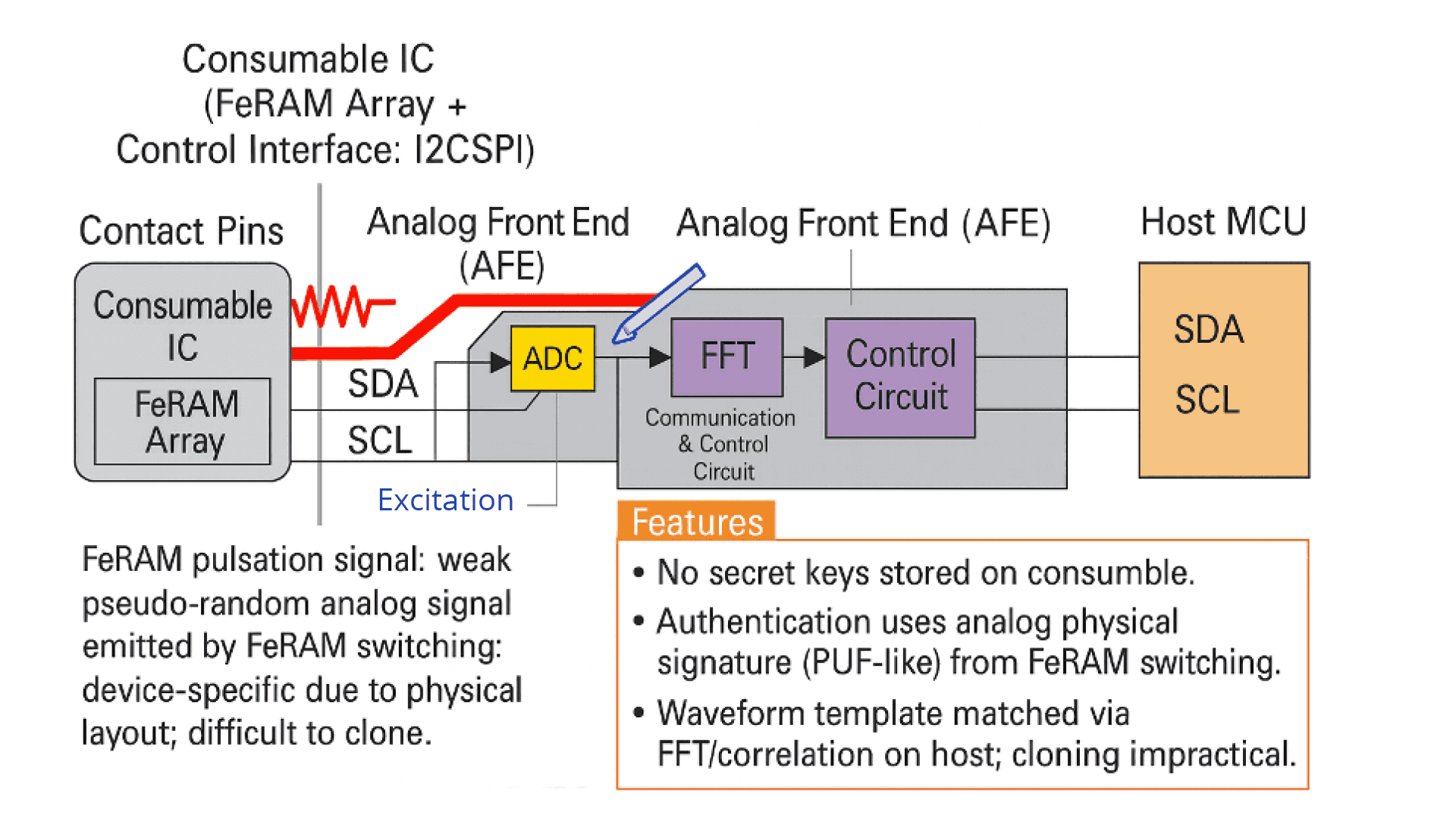 FeRAM-Based Spectral Authentication: Client (Consumable IC)–Host Signal Chain with Contact or RFID Power/Link
A practical solution uses a FeRAM client IC for the consumable and a companion AFE at the host to capture the analog signature and manage communications (I²C/SPI).
The table below compares representative characteristics of candidate memories used in secure, low‑density applications. Values are typical industry ranges; actual figures vary by vendor, geometry, and grade. For design, consult specific datasheets.
| Attribute | FeRAM | ReRAM | EEPROM | NOR Flash | NVSRAM |
|---|---|---|---|---|---|
| Density Range (typ.) | Kb–Mb (expanding) | Kb–10s of Mb (emerging) | Kb–Mb | Mb–Gb | Kb–Mb (SRAM + NVM shadow) |
| Endurance (write cycles) | 10^10–10^14 | 10^6–10^9 | 10^5–10^6 | 10^4–10^5 (per sector) | SRAM: ~unlimited / NVM shadow: 10^5–10^6 |
| Write Latency (byte/word) | ≈10–100 ns (SRAM‑like) | ≈100 ns–µs | ≈1–5 ms (program) | ≈10–200 µs (word/line) | SRAM writes: ns store/recall: µs–ms |
| Read Latency | ≈10–50 ns | ≈10–100 ns | ≈50–200 ns | ≈10–100 ns (XIP) | ≈10 ns (SRAM path) |
| Write Energy per bit | Very low | Low–moderate | High (charge pump) | Moderate (charge pump) | Low (SRAM), NVM copy higher |
| Data Retention @85°C | ≥10 years (typ.) | Target ≥10 years (design‑dependent) | 10–20 years | 10–20 years | Depends on NVM shadow (10–20 years) |
| Radiation / SEU Robustness | High (ferroelectric) | Moderate–high (cell‑dependent) | Moderate | Moderate | Varies (SRAM sensitive, controller ECC) |
| Operating Power | Very low, duty‑cycle friendly | Low | Moderate (program current) | Moderate (program current) | Low (active SRAM current) |
| Interface Availability | I²C, SPI, parallel (by device) | I²C, SPI (emerging) | I²C, SPI, Microwire | SPI, QSPI, parallel (XIP) | Parallel, SPI, I²C |
| Cost per Bit (relative) | High (but falling) | High (emerging) | High–moderate | Low (best among listed) | High (bill‑of‑materials) |
| Security Fit (anti‑counterfeit) | Excellent via spectral signature, no stored key | Good (PUF‑like variants possible) | Fair (requires stored secret) | Fair (requires stored secret) | Good (fast + controller, still needs secret) |
| Best‑Fit Use Cases | Authenticated tags, secure logs, battery‑less | Secure tags, embedded IDs (maturing) | Calibration, small data logs | Firmware storage, XIP code | Fast state retention, config shadowing |
Notes: Endurance and retention are temperature‑ and duty‑cycle‑dependent. (2) ReRAM characteristics vary significantly by material system and vendor implementation. (3) NVSRAM typically uses an SRAM front end with a nonvolatile shadow (e.g., EEPROM, MRAM); overall behavior depends on the shadow technology and controller policy.
Initial deployments favor contact‑based consumables due to straightforward signal integrity. Over time, densities and integration increase, enabling combined secure ID, small data logging, and analytics hooks.
Contact our technical sales team to request engineering samples, integration support, or design-in consultations.