
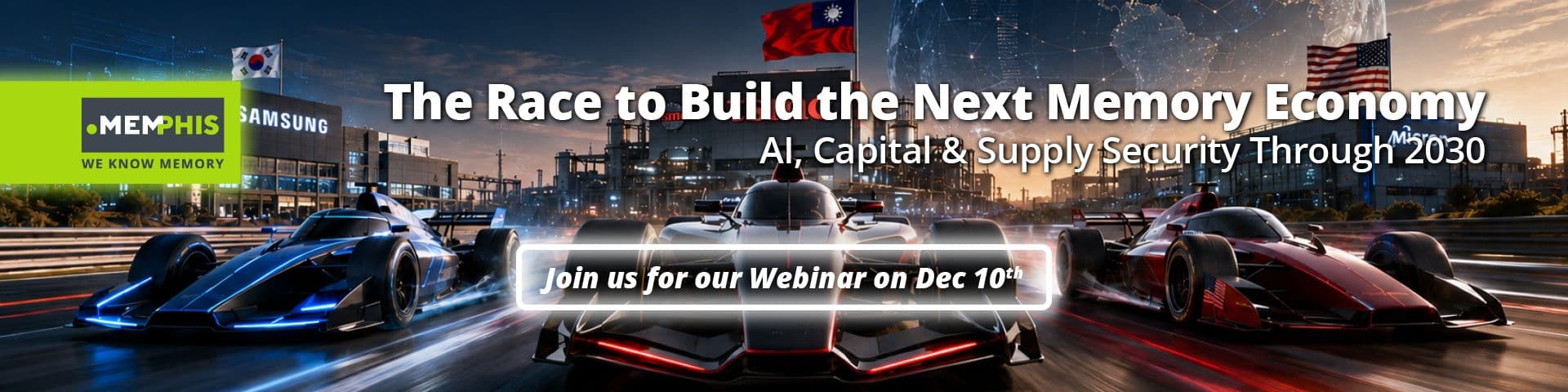
The Race to Build the Next Memory Economy
AI, Capital and Supply Security Through 2030
Thursday, 10 December 2026 | Two Global Live Sessions
The semiconductor memory industry is entering a period of structural transformation.
AI infrastructure, HBM, advanced packaging and next-generation computing are creating a new memory economy alongside the traditional DRAM and NAND cycle. At the same time, unprecedented capital commitments, technology transitions, regional industrial strategies and long-term supply agreements are redefining where capacity will be built, how it will be allocated and which companies will capture future value.
This 2026 Year-End webinar will provide a strategic, data-driven outlook on the forces shaping the global memory industry through 2030.
Key Topics
- AI and conventional memory demand convergence
The interaction between HBM-led growth, hyperscale infrastructure, and traditional server, mobile, PC, automotive, and industrial demand cycles. - The global investment and capacity race
Supplier capital expenditure, fab expansion, advanced-node migration, packaging constraints and the competition for strategic customer commitments. - Technology adoption through 2030
HBM4 and beyond, DDR5, LPDDR5X, CXL, advanced NAND architectures and next-generation packaging technologies. - Supply sufficiency and capacity allocation
The impact of AI-related production priorities on conventional DRAM, NAND and specialty-memory availability. - ASP elasticity and system-level optimization
How rising memory costs influence product configurations, memory content, launch timing, profitability and end-market demand. - Regional and application-level divergence
Different market outcomes across AI infrastructure, enterprise, mobile, PC, automotive and industrial applications—and across EMEA, the Americas and APAC. - Supplier positioning and geopolitical realignment
The evolving strategies of Samsung, SK hynix, Micron, CXMT, YMTC and other global memory suppliers. - Resilience and strategic supply commitments
Practical frameworks for LTAs, MOUs, capacity reservations, multi-sourcing, inventory planning and shared-risk commercial models. - 2027–2030 market scenarios
Implications for technology leadership, capital returns, pricing, supply security, product strategy and competitive positioning.
Participation is free and open to executives, investors, strategy leaders, sourcing and supply-chain professionals, product managers, technology teams, analysts and decision-makers across the global semiconductor and electronics ecosystem.
Our Speaker
Nikolaos Florous, Ph.D., Global Head of Product Marketing at Memphis Electronic, is a distinguished expert in electronics and semiconductor technologies, bringing over 18 years of expertise in Sales & Marketing across diverse electronics industry sectors, including Automotive, Telecom Infrastructure, Medical, Data Centers, IoT, and Consumer Electronics.
At Memphis Electronic, Nick spearheads the company’s Memory Competence Center, driving strategic product innovation, market expansion, and positioning in the evolving semiconductor landscape. His deep technical knowledge and market insights make him a pivotal figure in advancing memory solutions for next-generation applications.