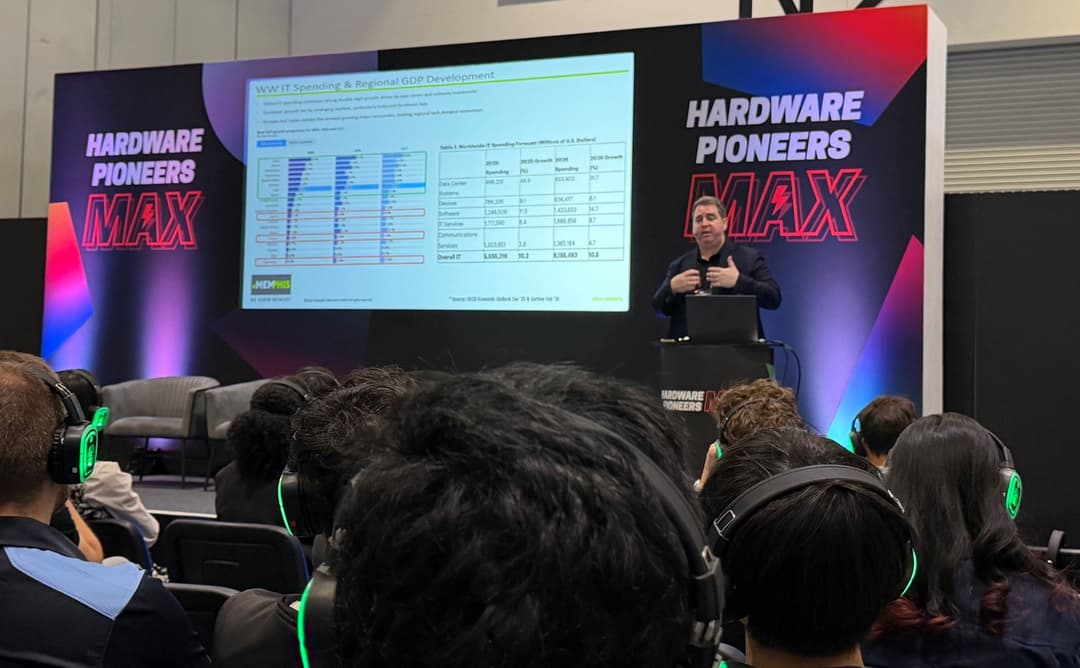
In June, we presented at two industry events, providing insights into the dynamics of the semiconductor memory market. The message is what we’ve been delivering for the past months, in our webinars and in direct discussions with our customers.
The global memory market is undergoing a fundamental transformation. Once defined by sharp cycles driven by consumer demand, the industry is now increasingly shaped by structural forces, most notably AI, hyperscale infrastructure, and geopolitical realignment.
Ultimately, we are witnessing a reset of how the memory market works.
AI workloads are fundamentally memory-intensive, requiring significantly higher DRAM and NAND content per system.
As a result, memory is becoming a critical enabler of performance in data centers and hyperscale environments. This has two major implications:
In contrast, traditional consumer-driven segments—such as PCs and smartphones—remain far more price-sensitive and cyclical.
Over the past three decades, the DRAM industry has consolidated dramatically—from more than 15 manufacturers in the 1990s to just three to four major players today.
This concentration is not accidental. The industry is defined by:
Building a leading-edge fab requires investments comparable to large-scale infrastructure projects—and returns materialize only over long time horizons.
In this environment, scale, discipline, and technology leadership determine competitiveness.
The competitive battleground is shifting toward advanced memory technologies, particularly high-bandwidth memory (HBM), which is critical for AI workloads.
At the same time, the market is splitting in two:
Short-term supply tightness—particularly in DDR4—reflects capacity being redirected toward next-generation technologies, with normalization expected only as migration progresses and additional capacity comes online.
The transition to higher layer counts (200+ layers) and the shift toward QLC architectures are slowing effective capacity ramp-up due to longer production cycles and more complex processes.
At the same time, suppliers remain disciplined, prioritizing DRAM and HBM investments and limiting aggressive NAND expansion.
The result: a structurally tighter supply environment with more stable pricing dynamics.
AI and enterprise applications have become the dominant drivers of memory revenue:
Meanwhile:
The industry is transitioning from a consumer-driven model to an infrastructure-driven ecosystem.
For companies across the value chain, this requires a shift:
We are on the brink of a new era that requires a new approach to product design and component procurement. Memory is no longer predictably cyclical but structurally constrained and demand-driven. This requires a proactive strategy, and a strong, knowledgeable partner like MEMPHIS at your side.
Reach out if you have any questions or want to discuss more.