
Nick Florous, Global Product Marketing Director at MEMPHIS Electronic
The global memory market is undergoing a fundamental regime change. What we are witnessing is not a classical cycle, but a structural bifurcation of the industry into two capital-starved segments — legacy and advanced — both experiencing shortages, but for entirely different reasons.
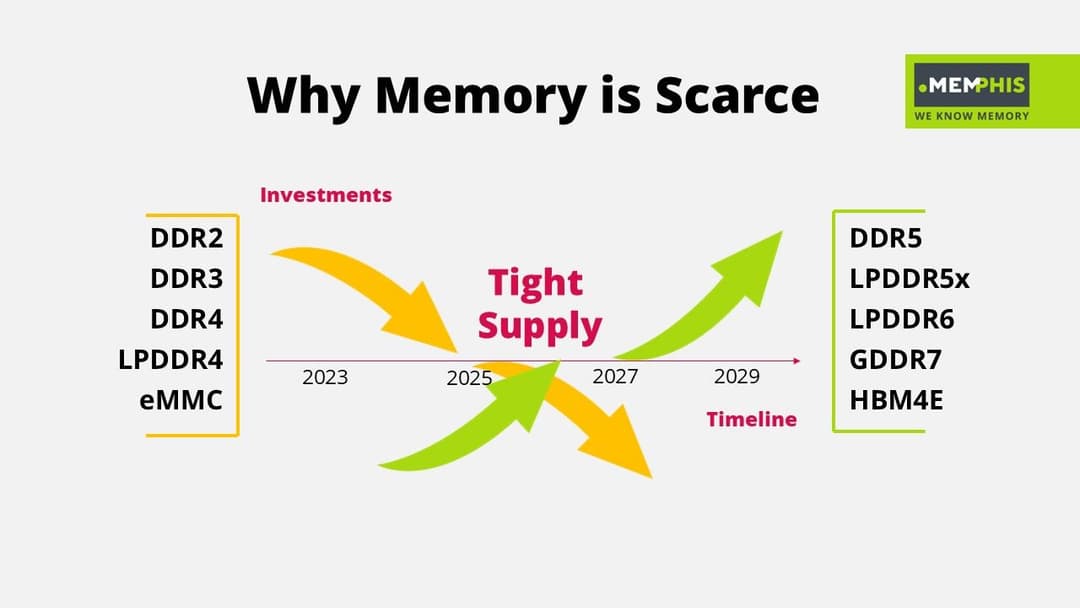
In 2023, memory products like DDR2, DDR3, DDR4, and LPDDR4, as well as flash memory such as MLC and eMMC, still enjoyed 100% fab support. But by 2025, capacity support already collapsed to ~40%, and by 2027–2028, most legacy nodes reach effective end-of-life, leaving only niche industrial, automotive, and defense volumes. The wafer output dedicated to these nodes will be 80–90% lower than in 2023, not because demand vanished, but because fabs, tools, and R&D budgets migrated toward AI-driven nodes.
Legacy memory is therefore not dying — it is becoming specialty silicon. Without EUV (extreme ultraviolet) lithography, hybrid bonding, CoWoS (Chip on Wafer on Substrate), or an advanced packaging pull, these nodes can no longer compete for capital against AI logic and HBM. That is why their ASPs become structurally high, even when unit demand is stable.
In parallel, advanced memories such as DDR5, LPDDR5X, LPDDR6, GDDR7, and HBM4E are constrained from the opposite direction. They require sub-15nm DRAM scaling, EUV, TSVs (Through Silicon Via), hybrid bonding, and advanced packaging, all of which are scarce and yield-limited.
A single HBM stack can consume the equivalent capacity of dozens of legacy DDR dies, while yield learning curves remain steep. Even with new fabs announced, economic output does not normalize before 2028+.
This creates the inversion: The old nodes are scarce while the new nodes are not ready.
Between 2025 and 2028, the market enters a dual-shortage regime where:
Memory is no longer a commodity cycle — it has become strategic infrastructure.
For automotive, industrial, telecom, and embedded OEMs, legacy parts now behave like long-life aerospace components, requiring lifetime buys and guaranteed allocations.
For AI, cloud, and hyperscalers, advanced memory becomes a geopolitical and supply-chain bottleneck tied to EUV tools, packaging capacity, and a handful of fabs.
The winners of the next decade will not be those who chase spot prices — but those who lock in technology, allocation, and partnerships ahead of time.
MEMPHIS Electronic GmbH
Basler Str. 5
61352 Bad Homburg
Germany
Phone: +49 6172 90350
Email: info@memphis.de