
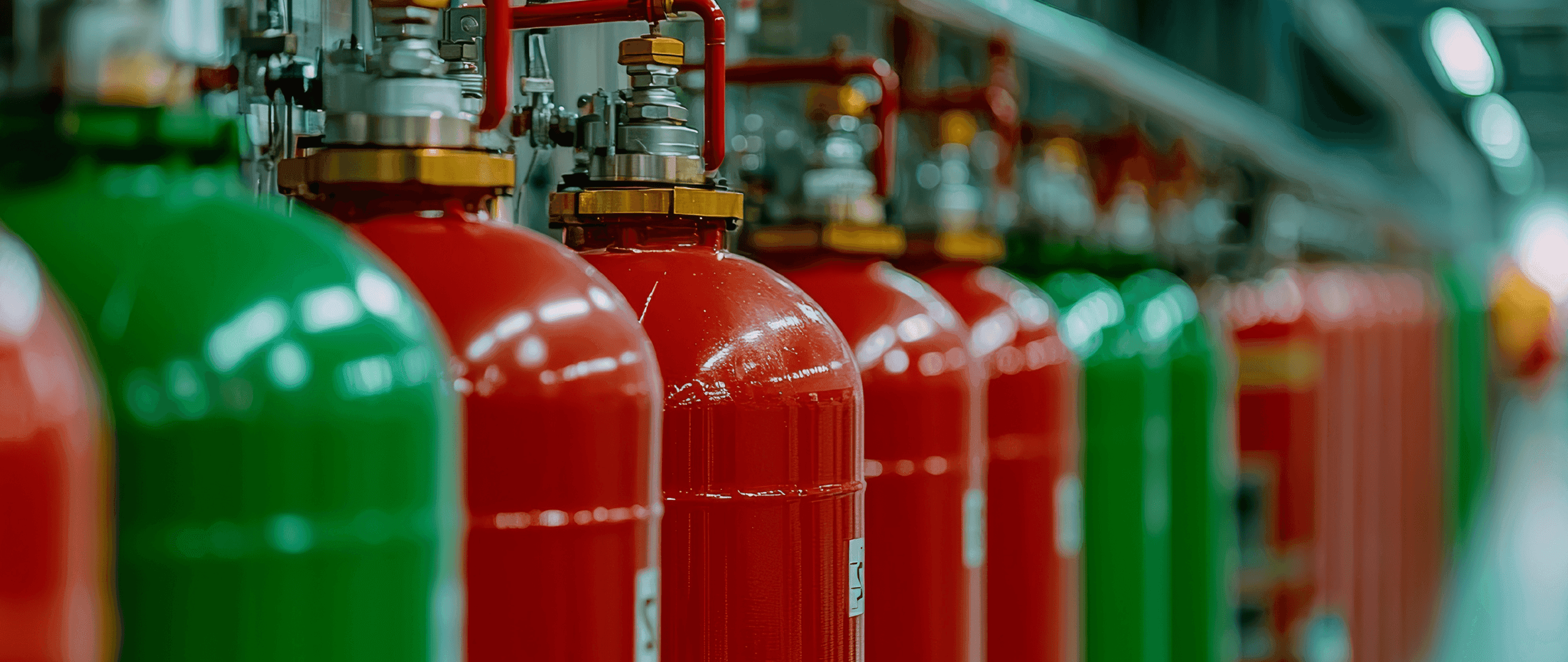
As fire suppression and safety systems evolve toward greater intelligence and autonomy, memory components play a central role in ensuring system reliability, data integrity, and real-time responsiveness. These embedded systems must retain safety-critical data across power losses, support high-frequency logging, and operate reliably in harsh environments.
This paper explores Ferroelectric RAM (FeRAM) as an advanced non-volatile memory (NVM) technology for such systems. It provides a comparative analysis with other mainstream memory technologies like EEPROM, Flash, MRAM, SRAM, and DRAM, and defines the Critical-to-Quality (CTQ) attributes required in the context of fire suppression, especially gas-based suppression systems, which demand the highest reliability and compliance.
Modern fire suppression systems integrate embedded microcontrollers, sensors, and actuators to deliver real-time protection. Memory components in these systems fulfill several vital functions:
In gas-based suppression systems, which typically involve CO₂, inert gases, or clean agents (e.g., FM-200, Novec), these memory demands are particularly stringent due to:
Ferroelectric RAM (FeRAM) combines the speed of SRAM with the non-volatility of EEPROM and Flash. It stores binary data using a ferroelectric layer that maintains polarization state even when power is removed.
Key Characteristics:
| Feature / Memory Type | FeRAM | EEPROM | Flash | MRAM | SRAM | DRAM |
|---|---|---|---|---|---|---|
| Non-volatility | Yes | Yes | Yes | Yes | No | No |
| Access speed | ~50–100 ns | µs–ms | ~1 µs | ~30–50 ns | ~10 ns | ~10–15 ns |
| Write endurance | ≥10¹² | ~10⁶ | ~10⁵ | ~10⁹–10¹² | ≥10¹⁶ | ≥10¹⁶ |
| Power consumption | Very low | Moderate | Moderate | Low–Moderate | High | Moderate–High |
| Radiation/EMI resistance | High | Low | Low | High | Low | Low |
| Data retention (@85°C) | ≥10 years | ~10 years | ~10 years | ≥10 years | N/A | N/A |
| Cost per bit | Moderate | Low | Low | High | Moderate | Low |
Gas-based suppression systems present one of the most demanding use cases for memory technology due to the instantaneous, irreversible nature of actuation, the criticality of configuration data, and stringent regulatory oversight.
System Functions Requiring Non-Volatile Memory:
CTQs for Memory in Gas-Based Suppression Systems:
| Category | Critical Requirement | Target Value / Spec |
|---|---|---|
| Non-volatility | Data must survive unexpected power loss | ≥10 years at 85°C |
| Write endurance | Must support frequent updates (diagnostics, logs) | ≥10⁹ write cycles |
| Access latency | Required for real-time safety response | ≤100 ns |
| Retention during EMI | Must tolerate industrial EMI and transients | Must pass IEC 61000-4-4/5 |
| Thermal tolerance | Must operate in mechanical rooms or control cabinets | –40°C to +125°C |
| Radiation resistance | Optional, for systems in power generation or aerospace | Must tolerate cosmic radiation and SEUs |
| Footprint | Must integrate in compact, space-limited devices | ≤8mm² (preferred package: WLCSP/QFN/SOP) |
| Interface compatibility | Must work with industrial MCUs | SPI / I²C / parallel |
| Power efficiency | Must suit battery-backed or standby-supplied devices | <1 µA standby, <1 mA active |
| Compliance support | Data must be auditable and securely stored | Supports IEC and NFPA standards |
| Application Domain | Use Cases | Memory Requirements Met by FeRAM |
|---|---|---|
| Detection & Sensor Nodes | Alarm triggers, fault memory, configuration storage | Fast, low-power, high endurance |
| Water/Foam/Mist Suppression Units | Mixture logs, pressure settings, maintenance records | Persistent and frequent write logging |
| Autonomous Mobile Units | Embedded control firmware and diagnostics | Radiation/thermal tolerance and compactness |
| Hazard Management Systems | Centralized logging, configuration, audit trails | Secure, non-volatile data retention |
Where FeRAM Replaces Other Memories:
System-Level Benefits:
FeRAM represents a compelling memory solution for safety-critical, high-reliability, and real-time fire suppression systems, particularly in gas-based applications. Its inherent non-volatility, speed, endurance, and resistance to harsh conditions meet or exceed the critical-to-quality (CTQ) requirements for such embedded platforms. In an era where compliance, resilience, and autonomous functionality define the next generation of fire suppression systems, FeRAM delivers a robust, future-ready alternative to legacy non-volatile memories.
Contact our technical sales team to request engineering samples, integration support, or design-in consultations.